Carvel
Carvel+_2_EF2020.jpg

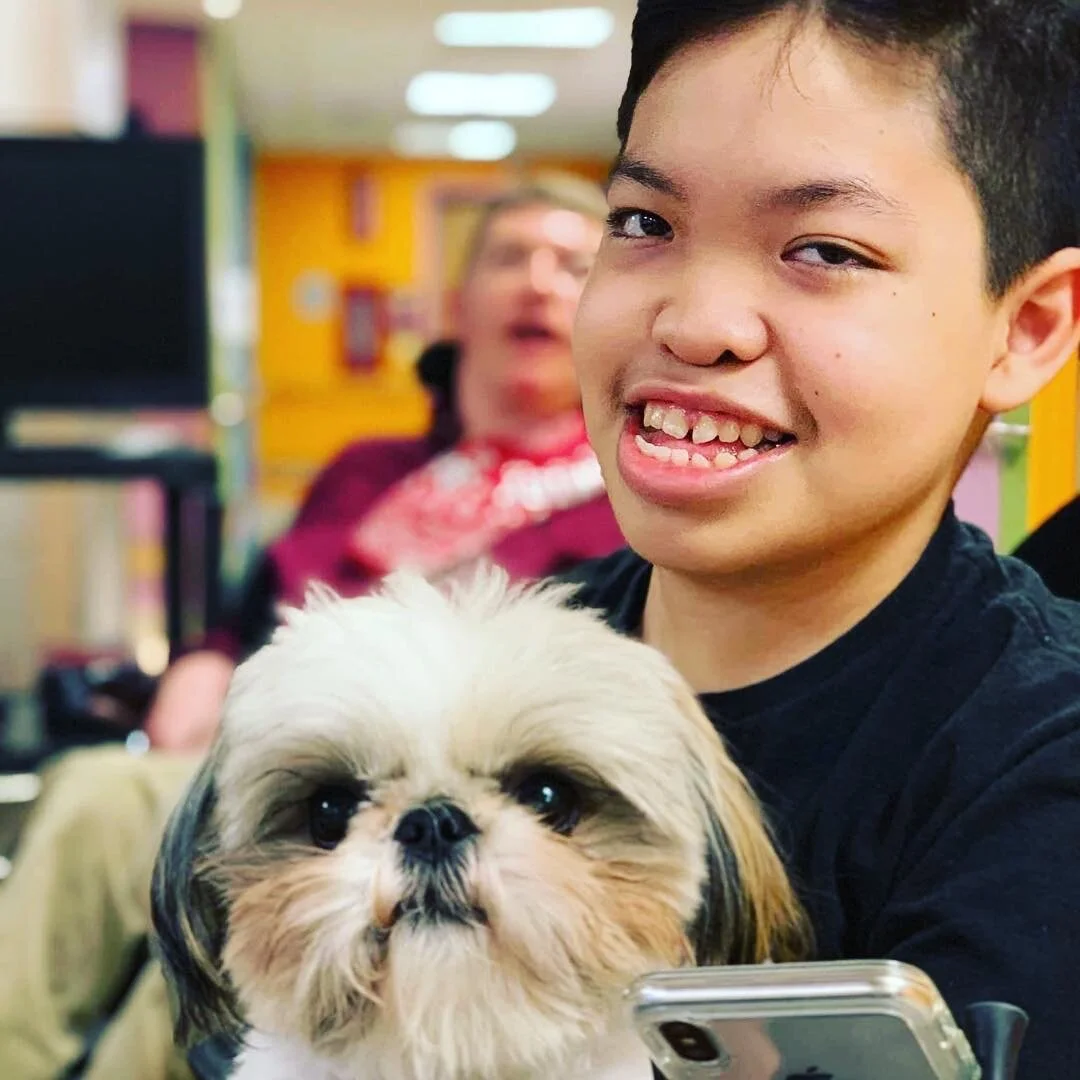
Carvel is a 17-year-old teen with autism, sensory processing and verbal expression challenges. An evaluation showed Carvel would benefit from an iPad for word recall and putting sentences together to increase his communication ability. He currently communicates using two-to three-word phrases, but the iPad will help open Carvel’s world. Carvel’s mom, a single mom raising five children, shared that Carvel also wants to be social but needs technology to assist him in communicating and being independent. She added that the iPad will help her son immensely.

In his spare time, Carvel loves to sing, draw and build elaborate Lego sets. He also swims and plays basketball on a local Special Olympics team.

2020Nate Nashawardee
Dan
Dan_EF2020.JPG

When Dan’s mom first learned about The Eric Fund through a parent group she belongs to, she was hoping her son could finally get an iPad of his own to help him communicate.

Dan, a 16-year-old teen on the autism spectrum, has challenges communicating verbally and uses an old iPad issued to him through school. His school iPad cannot be updated without permission. Plus, Dan and his family are nervous for him to take the school iPad outside the house or school for fear it will break or something will happen to it. This issue has been exacerbated by the pandemic. With his school iPad being his connection to learning right now, any damage to it could jeopardize his education and repairs would take a long time.

Dan was thrilled to receive from The Eric Fund an iPad of his own to take anywhere he goes, a keyboard and gift card for a specialized app. Dan’s iPad includes the LAMP Words for Life app, a communication tool that works well for him.

Dan and his family look forward to the greater independence the new iPad can bring. “We’re super excited that he is going to have his own device that will grow with him,” his mom said. “It is something that can be with him at all times that he can use to communicate with other people.”

When he’s not in school (which he really enjoys), Dan loves sports, especially basketball, swimming and adaptive skiing. He enjoys spending time with his family, doing things with his big brother, and going to the beach. Dan and his family look forward to an exciting new chapter of communication and greater independence with his new iPad.

2020Nate Nashawardee
Ibem
Ibem_EF2020.jpg

Ibem is a 30-year-old man with developmental and cognitive disabilities, short-term memory challenges, as well as executive functioning and auditory processing conditions. Ibem’s evaluation showed an iPad would be a good fit for him. The iPad he received from The Eric Fund will help him better communicate, organize himself, and use assistive technology as he actively looks for supported employment. An iPad would help him make that successful transition to a workplace and have job success by keeping him on task, on track, and communicating more effectively.

A high school graduate who attended community college, Ibem completed a four-year program and earned his apprenticeship diploma in plumbing. He plans to study and take the licensing exam to become a plumber in the future after serving as an apprentice in the field for a while. Ibem’s mother shared that the iPad will help him greatly in achieving that goal and many others.

In his leisure time, Ibem enjoys puzzles and virtual calls with his sister and her new baby. Before COVID-19, Ibem was volunteering

at his church and at the Northern Virginia affiliate of Rebuilding Together, a home rebuilding and repair organization. Fortunately, these groups have regular socials on Zoom that he now participates in to stay connected. Now that Ibem has his own iPad, he can participate in calls on his schedule as he won’t have to share the family computer.

Ibem was in his own assisted living apartment for the past four years until COVID-19 began and he wasn’t able to get the personal care he required. It was a difficult decision, but his mother determined he needed to be at home with her. He looks forward to returning to his own apartment with his new iPad once the pandemic is over.

2020Nate Nashawardee
Garvin
Garvin_EF2020.jpg

Garvin is an 18-year-old young man with intellectual disabilities, speech & language challenges and other health issues. He was evaluated for an iPad and was shown to have success with it. Assistive technology like an iPad will help Garvin in school and in the community. The iPad he received from The Eric Fund will help him with reminders, visual reminders, cueing and note taking. Garvin has challenges keeping up with note taking due to his handwriting speed. The voice-to-text feature of the iPad will help him as he has limited ability to express himself in writing. The iPad will help Garvin with school, homework and employment exploration.

When he’s not in school, Garvin enjoys music and has had DJ gigs for the local ARC chapter and other organizations. He has also been actively involved in a program called the I’m Determined Project, a state-directed program funded by the Virginia Department of Education, that focuses on providing direct instruction, models and opportunities to practice skills associated with self-determined behavior. This project facilitates youth, especially youth with disabilities, to undertake a measure of control in their lives, helping to set and steer their own course rather than remaining the silent passenger. Garvin’s mother said the program has been very good for him and wanted to share information about it.

2020Nate Nashawardee
Richard
Richard_EF2019.jpg

From the time Richard took and absorbed his sister’s math and computer programming book when he was in middle school, his interest in all things computers was undeniable. Richard, who is on the autism spectrum and lives with ADHD and other disabilities, is now 19 and attends a tech lab at his high school. Richard’s computer skills have grown exponentially, recently programming a virtual reality video game with two of his friends, and spending his free time creating games, animations and programming computers. When Richard’s laptop was accidentally broken on the bus beyond repair, a new computer was not in his family’s budget. The Eric Fund is proud to purchase a new laptop and computer bag for Richard so he can continue pursuing his interest in computers, building skills that will help him when he is ready to land a job.

2019Nate Nashawardee
Priscilla
Priscilla_EF2019.jpg

Priscilla is a 56-year-old woman from Washington, DC, with visual disabilities and albinism, who works for the DC government. When the existing magnifying screen and reader she received through her job was old and did not work reliably, she sought other options to help her get equipment that would make her job easier. The Eric Fund purchased a brand new magnifying screen for Priscilla that will enlarge her computer as well as be able to scan and enlarge papers and other hardcopy media for easy viewing. Priscilla was thrilled to receive her new magnifying screen, and is happy that the device is hers to use at work or at home.

2019Nate Nashawardee
Marccelo
Marccelo_EF+2019.jpg

Marccelo is a 14-year-old boy from Springfield, VA, who misses playing video games and connecting with friends online. Marccelo suddenly began to lose function in his hands, arms and legs and now uses a wheelchair. His therapist recommended “life changing” assistive technology that would help Marccelo use a phone and computer to participate with friends socially and via video games. While a private donor purchased an adaptive Xbox controller for him, Marccelo’s existing Xbox is old and does not support new adaptive devices. The Eric Fund is purchasing an adaptive joystick controller and new Xbox to help Marccelo once again play video games with his friends. The Eric Fund is also providing a switch, iPad and case. “He is going to be so excited,” said his mom, Guissela. “Thank you so much to The Eric Fund for getting this equipment for Marccelo. We can’t thank you enough.”

2019Nate Nashawardee
Karina
Karina_EF2019.jpg

Karina is a vivacious 20-year-old woman with cerebral palsy from Springfield, VA. Karina uses a manual wheelchair, but struggled to operate it optimally around her high school campus and in the community. With an electric wheelchair out of her family’s financial reach, Karina’s therapists at her high school tested a device that would convert her manual wheelchair into a power chair when needed, enabling her to navigate her world at a pace that matches her energetic personality. The Eric Fund is honored to purchase a SmartDrive device for Karina, which will help power her wheelchair and her dreams, as she gets ready to embark on a new chapter in her life.

2019Nate Nashawardee
Stephanie
Stephanie_EF2019.jpg

Stephanie is an active, 41-year-old woman from Springfield, VA, who is part of the Undiagnosed Disease Network at the National Institutes of Health. It has been difficult for Stephanie to get funding for a wheelchair since she doesn’t have an official diagnosis. She has a neuromuscular condition that reduces her stamina, making it necessary to use a wheelchair when out of the house. She requested a Fold & Go electric wheelchair that is heavy duty and good for outdoor activities. Stephanie enjoys being outside and exploring new things. On her first official outing with her new equipment, she used the chair to go to Great Falls, Virginia. She said the gravel paths were bumpy, but she was able to navigate them well, especially with the help of the self-propel feature. Stephanie plans to have more exciting adventures with her new wheelchair.

2019Nate Nashawardee
Joshua
Joshua_EF2019.jpg

Joshua is a 19-year-old young man with intellectual disabilities from Washington, DC, who works hard and chases his dreams. Once told he would never read or write, Joshua is a high school honors student and a member of his school’s distinguished Core Leader Team, working with parents, students and teachers. The Eric Fund is purchasing an iPad mini for Joshua so he can use a special reading app that will help him read books and notes as well as record some of his classes for note taking. The iPad will help Joshua continue to excel at school at beyond.

2019Nate Nashawardee
Derricke
Derricke_EF2019.jpg

Derricke is and active 8-year-old boy from Woodbridge, VA, with spinal muscular atrophy. His condition causes weak muscles, making it a challenge to move independently and requires use of a wheelchair. Derricke wants to be able to ride a bicycle in the neighborhood like his brothers and friends. He was evaluated for an adaptive tricycle and it was recommended not only for his social involvement, but also to build his muscles, stamina, endurance and mobility. The bicycle is not covered by insurance, so The Eric Fund was honored to purchase one for Derricke.

Derricke’s mother said that means the world to her that her son has a bike of his own, allowing him to go outside and play with other children. He loved using the bike at physical therapy and he was thrilled when he found out he was getting one of his own to use at home.

2019Nate Nashawardee
Anjie
Anjanette_EF2019.jpg

Anjie is 55 years old and has had polio since birth, but did not know she was entitled to assistance, therapy and other services until she was 28 years old. The delay in receiving assistance caused her condition to worsen, making it painful to walk. She requested a power mobility scooter to get out and about more and have more interaction in her Washington, DC community. Now Anjie can run errands and attend things she normally would not have been able to do.

2019Nate Nashawardee
Jacob
Jacob_EF2019.jpg

Jacob is a 5-year-old boy from Rockville, MD, who has a genetic condition that causes benign tumors to grow throughout his major organs and for Jacob, most notably in the brain. The benign brain tumors have caused epilepsy and developmental delays including speech delays as his greatest challenge. Jacob uses an assistive device at school that has provided him some level of independence communicating and advocating for himself. The Eric Fund is pleased to award Jacob an iPad with applications that can be customized for his specific needs and that can be with him at home and when he transitions from school to camp to kindergarten. His mother said that when Jacob opened up his new “words” device, “his face lit up. It was wonderful to see him realize he could connect now. Thank you so much for making this possible for our family,” she said.

2019Nate Nashawardee
Ngozi Tabbs
NGOZI TABBS.jpg

When Ngozi Tabbs learned more than three years ago that she had multiple sclerosis (MS), the diagnosis was difficult to process. As a social worker assisting people in Washington, DC, living with mental illness and homelessness, Ngozi (pronounced “Ann-ga-zee”) was a fierce and compassionate advocate for the people she worked with, and now had to advocate for herself as she navigated a new chapter in her life.

But for Ngozi, who put herself through college for both her Bachelor’s and Master’s degrees as a single mom, “no” or “can’t” was not an option. She was determined to get the expensive equipment she needed.

When the stairs in her southern Maryland home became difficult to use and she experienced several falls, Ngozi looked for funding to install a stair lift in her home for more than two years. After the National Multiple Sclerosis Society (NMSS) pledged $1,500, Ngozi applied for an Eric Fund grant for the remainder of the more than $9,000 still needed for the stair lift. Due to extra funds raised the year prior, The Eric Fund board approved additional funding for Ngozi, with the remainder raised by the generous donors at The Eric Fund 20th Anniversary celebration in September, which Ngozi attended with her daughter.

Thanks to the generosity of The Eric Fund and its supporters in partnership with NMSS, Ngozi’s stair lift is completely funded. Her custom stair lift is being manufactured and will be installed soon. “I’m just so excited to get the equipment needed to assist me to keep me in my home,” she said.

2018Nate Nashawardee
Ammar Walcott
AMMAR WALCOTT.jpg

Ammar Walcott is the older of two autistic twins who just celebrated their 18th birthday. (He is also one of six children!) His autism primary affects his communication skills resulting in the need for a high level of support to participate in social and functional activities.

Ammar attends high school as part of a certificate program, where he receives special education, occupational therapy and speech therapy services. A visual learner, he has had success in school using an iPad, where visual applications like Boardmaker Online and ChoiceBoard Creator provide the visual and auditory cues that are most effective in getting him to “use his words” to express his needs.

These programs enable Ammar to access visual communication boards that help guide his verbal output. They also provide things like checklists, visual schedules and timers, which all help promote independence with completion of functional tasks like meal prep, cleaning and working tasks.

The Eric Fund is pleased to award Ammar his own iPad (and necessary apps) for use at home so that he can have continuity from school to home, a necessary component of his path toward increased independence. His mother was effusive with her appreciation, and loved the timing – he received his iPad so near his birthday, it felt like a birthday gift. “This is a real gift for Ammar,” she said, “and the ability to communicate better with Ammar is a gift for our entire family.”

2018Nate Nashawardee
Natalie Chirinos
NATALIE CHIRINOS.jpg

Natalie Chirinos is a 15-year-old girl who is blind and has Dandy-Walker Syndrome, a disability that affects muscle coordination. Because she has difficulty standing safely without the assistance of a physical therapist, she is home-schooled by her grandmother, whose second language is English. Because of these numerous challenges, Natalie receives around-the-clock personal care. Her Support Coordinator in Prince William County reached out to The Eric Fund to help her apply for a standing walker – a device not covered by insurance – which would help Natalie transition safely from a sitting to standing position at home, an important “first step” toward performing this task independently and voluntarily. Being able to stand on her own will also help preserve Natalie’s existing range of motion.

“The Eric Fund is providing Natalie with the first piece of technology that she has ever had that will help her have some control over her actions and do something independently,” her support coordinator said. “It may seem like nothing, but to Natalie it has a hugely positive impact on her quality of life.”

2018Nate Nashawardee
Jake Jaffe
JAKE JAFFE.jpg

Jake Jaffe is a kind, loving 11-year-old boy who has Down syndrome and autism spectrum dis- order. The combination of these disabilities makes communication the most challenging issue that Jake confronts daily. He has challenges expressing himself verbally, and is only able to use two-word sentences to express his needs. Jake has difficulty connecting with other children because he doesn’t have the words to engage in social interactions.

Jake tried a variety of augmentative communication devices (AAC) but as his mom and speech pathologist observed him independently navigating the buttons on the Tobii Dynavox Indi, it was clear that that was the device he “clicked” with. They looked on as he became animated and excited, and interested in learning more.

The Jaffes learned about The Eric Fund by word-of-mouth from another family whose son had previously received a life-changing AAC device. They applied for partial funding, to cover the cost of the device that insurance wouldn’t cover, and were thrilled to learn that they had been chosen to receive it.

“The Eric Fund is truly a wonderful organization and we really, really appreciate all that you have done for us,” said Jake’s mom, Chiara.

“The device has made such a big difference in Jake’s life with respect to his ability to communicate with his teachers and peers. I read the [Eric Fund] newsletter as well, and it was so wonderful to see the huge impact that the funding has had on other people who needed assistive devices.”

2018Nate Nashawardee
Emilia
Emilia_Yerovi_Photo 1.jpeg

Eight-year-old Emilia is now riding in style in Northern Virginia with a new wheelchair and car seat from The Eric Fund. Emilia, who has cerebral palsy, epilepsy, as well as physical and intellectual disabilities, outgrew her adaptive stroller to the point it was negatively impacting her positioning and posture. Emilia’s parents did not have the financial means to afford the necessary equipment for Emilia and turned to The Eric Fund for help.

The Eric Fund purchased a new wheelchair and adaptive car seat custom made for Emilia. Her parents were so grateful for the equipment for their daughter, they decided to help another family in need by donating Emilia’s old adaptive stroller that was still in good condition. With all of the necessary safety features and adaptations, Emilia is on her way to being more independent at school and at home. “It’s great,” says her father. “I can’t tell you what a difference this has made.”

2017Nate Nashawardee
Carolena Garrison
CarolenaG2017.jpg

One of the things Carolena Garrison enjoys most about her job as a restaurant hostess in Northern Virginia is the people – the regular customers, coworkers and managers she gets to work with each week. But now, thanks to a cutting-edge piece of technology provided by The Eric Fund, Carolena, who is legally blind, will be able to greet her family, friends, regular customers and coworkers before they even speak a word.

The Eric Fund purchased for Carolena an Orcam MyEye, a special camera device that mounts on glasses and acts as a visual aid for people with low vision. The MyEye’s facial recognition software can be programmed to recognize a number of people. When the camera sees a familiar face, it will speak the person’s identity into an earpiece Carolena wears. The MyEye also translates images and writing through the earpiece, allowing Carolena to read printed words on anything from forms to menus. Currently, Carolena requires assistance to read the restaurant’s table map to seat customers. “With the technology, I can run the floor plan and help my customers,” says Carolena. “(The MyEye) will make my job a lot easier for me. It will me give me more independence.” The Eric Fund is honored to provide this important piece of equipment to advance Carolena’s independence at home, work and in the community.

2017Nate Nashawardee
Francis Dwyer
FrancisDwyer.JPG

Francis Dwyer is a 27-year-old young man living with Downs Syndrome, who has already reached many milestones in his quest to live as independently in his community as he possibly can.

Although Francis had a part-time job at the time his application was submitted, he was relying heavily on a job coach to help him complete the requirements of his job, rather than working more independently. Francis, along with his mother, his job coach and his AT specialist, mapped out a list of goals and implementation strategies to make progress in three key areas of his life: work/vocational skills, activities of daily living, and community living and recreation.

His mother, Jeanne, aware of what a difference some simple apps could make in her son’s life, applied for an Eric Fund grant on her son’s behalf in hopes of securing an iPad for Francis, and the Ablelink, Endeavor 3 app and Google Calendar.

One challenge that Francis faces in his day-to-day life is remembering what tasks he needs to complete and at what time. The app is an iPad-based monitoring system that helps an individual live more independently by creating daily schedules for work and activities of daily living, daily medication reminders, all things with which Francis needs assistance. The Endeavor 3 is helping Francis create a weekly calendar with visual and auditory reminders of what he needs to accomplish. He hopes to one day use it to help him learn how to follow a recipe and cook a simple meal. Francis’s mother expressed her extreme gratitude to The Eric Fund for providing the technology that will enable her son to continue his progress on his path toward independence.

2017Nate Nashawardee